 Wholesale Handler
Orderlion alternative for wholesalers
Orderlion is an ordering platform for food and drink distributors. The product is capable - AI order parsing, 200+ ERP integrations, field sales apps, white-label branding. But the feature set is built for large operations, and the pricing follows. For smaller wholesalers, there's usually a simpler and cheaper alternative.
If you've looked at Orderlion and concluded it doesn't fit, you're not alone - there's usually a simpler, cheaper tool that does the job.
What is Orderlion?
Orderlion is a Vienna-based ordering and operations platform for wholesalers in fruit & veg, seafood, drinks, baked goods, cash & carry, and chilled & frozen distribution. The platform sits between your customers and your ERP system - customers place orders through an app or web shop, and orders flow into your back-office software automatically.
Their headline features are the AI Inbox (which parses email, WhatsApp, and voicemail orders into structured entries) and a wide library of ERP integrations.
Why look for an Orderlion alternative?
Four common reasons.
1. No public pricing
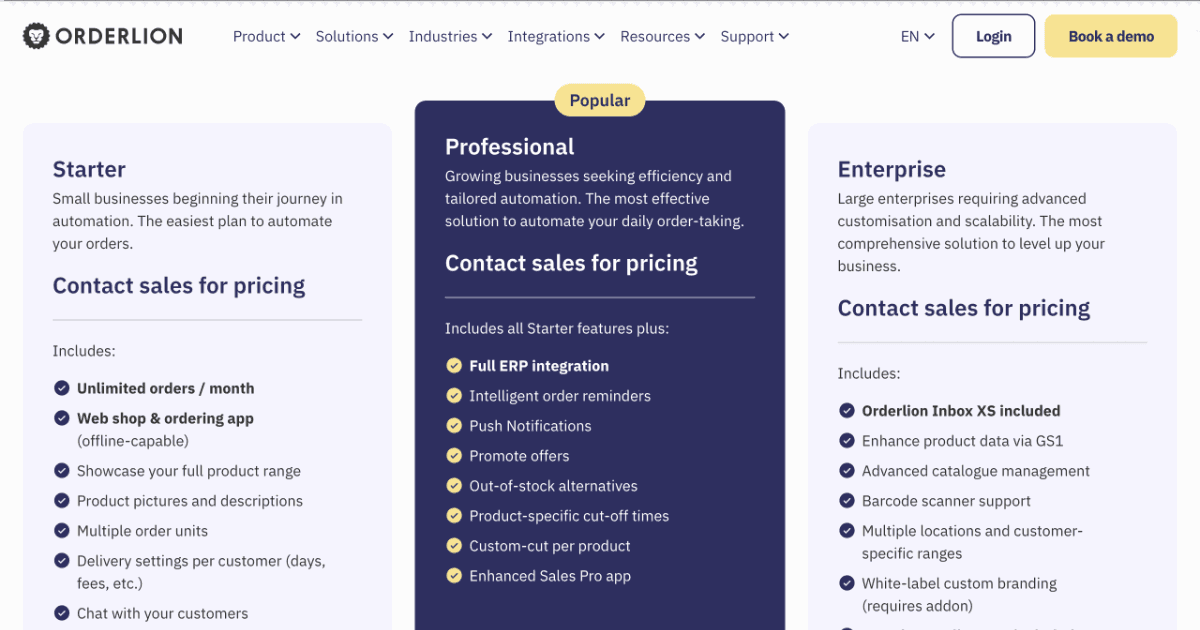
Every tier on Orderlion's pricing page says "contact sales." Starter, Professional, Enterprise - no numbers anywhere.
Based on their 2021 public revenue disclosure, the average customer was paying roughly $722/month. That's an average across all tiers, so real numbers vary - but there's no way to know what you'd actually pay without booking a call.
For wholesalers who are still evaluating, that's a high-friction first step, and it is a standard part of how this category is priced. (See the full pricing breakdown in the Orderlion pricing article.)
2. The ERP trap
Orderlion's best features assume you have an ERP system. The AI Inbox feeds parsed orders into SAP, Microsoft Dynamics, Sage, or one of 200+ other systems. The reconciliation, the automation, the field sales tools - they all expect ERP-synced data.
Most small wholesalers don't have an ERP. They have a spreadsheet, maybe Xero or QuickBooks for accounts, and a phone that won't stop buzzing.
So the choice becomes: pay enterprise prices and use Orderlion as a basic ordering app, or buy an ERP to unlock the features bundled in. Either way, the spend doesn't match what's getting used.
3. The implementation overhead
Orderlion publishes 28 pages of documentation just for wholesalers. Seven of those pages are about how to invite a customer. The wiki admits that only around 30 percent of customers respond to the first invitation - 50 percent after a second nag.
There are four different invitation channels on desktop, plus separate mobile methods. Logistics setup involves manually selecting which customers each delivery date applies to. Product import needs a wizard.
This is platform-grade software. The implementation effort matches. For a wholesaler with 20 to 50 customers, that's a lot of operational overhead before the product starts paying off.
4. The AI Inbox solves the wrong problem
Orderlion's flagship feature is AI that processes messy WhatsApp, email, and voicemail orders. The workflow is:
- Customer sends an order via WhatsApp, email, or voicemail
- AI parses the message and guesses what they meant
- A human reviews and approves the AI's interpretation
- Order goes to the ERP
The customer experience hasn't changed. Customers are still ordering the same chaotic way - texting "2 boxes tomatoes and some of those peppers from last time" at 10pm. The AI just adds an interpretation layer.
Orderlion automates the mess. Wholesale Handler prevents it.
With a self-service ordering portal, the same customer opens the product list, sees their assigned prices, picks what they need, and submits. The order arrives clean. No AI guessing. No human review step. No "did the system understand that?"
Who is Orderlion actually built for?
Orderlion is built for medium-to-large food and drink distributors. The customer profile is roughly:
- 100+ regular trade customers
- An existing ERP system (or budget to buy one)
- Field sales representatives who need a mobile app
- Multiple warehouse locations
- Budget for software well into the hundreds per month
If that describes your operation, Orderlion is a serious tool. The AI Inbox, ERP integrations, and Sales Pro app exist for exactly that scale.
If it doesn't, the fit isn't there. The features priced into the bill don't match the way smaller wholesalers actually run. Orderlion alternative for wholesale bakeries runs that comparison for a bakery, where the cutoff protects a bake and the orders have to become a production list.
What to look for in an Orderlion alternative
Whatever tool you pick, the criteria for a small wholesale operation are usually:
- Transparent pricing - a number on the website, not a sales call
- No ERP requirement - the tool works standalone, not as a layer on top of enterprise software
- A customer-side ordering portal - customers order from a real product list, not via email or WhatsApp that something else has to interpret
- Self-service onboarding - you can sign up, set up products, invite customers, and start taking orders without a kickoff call
- Operational features included - cutoff times, delivery day scheduling, customer price lists, and invoicing should all work on the entry plan, not be locked behind a higher tier
- Standing orders that generate themselves - for a café that takes the same order every Tuesday, the right answer isn't a push-notification reminder to re-submit. It's a schedule that places the order automatically at that delivery day's cutoff, with pause, skip, and schedule updates built in. Orderlion's workaround for standing customers is favourites lists plus reminders; the customer still has to open the app and submit each time.
Anything that fails these is the same shape of problem as Orderlion, just at a different scale.
How Wholesale Handler compares
Wholesale Handler is a focused ordering portal for small wholesalers. It's built around the criteria above.
Orderlion has features Wholesale Handler doesn't - AI order parsing, ERP integrations, field sales app, white-label branding, multi-location support. If you need those, the price is justified.
If not, the choice is between an enterprise platform that won't get fully used and a tool built for smaller operations.
Try it without a sales call
Wholesale Handler has a live public demo. No account, no email address, no calendar booking - click the link and you're inside a working merchant account with seeded products and customers. You can place orders, update price lists, and generate invoices.
If you've been put off by Orderlion's "contact sales" wall, that's the easiest way to see whether a simpler tool covers what you actually need.
Who should still pick Orderlion
Some wholesalers genuinely fit Orderlion's profile:
- Large fresh produce or food distributors processing hundreds of daily orders
- Operations with an ERP and a real need for orders flowing into it automatically
- Businesses with field sales reps who need a dedicated mobile app
- Customers who genuinely will not switch from email and WhatsApp ordering, and need the AI layer to stay sane
If that's you, Orderlion exists for that scale, and there's no reason to switch.
If it's not, the answer to "what's a good Orderlion alternative for wholesalers?" is almost always: a simpler, cheaper tool that works without an ERP. That's what Wholesale Handler is built to be.
Last verified 7 May 2026.Relative time loading...