 Wholesale Handler
Shopify alternative for egg wholesalers
Shopify is one of the world's best retail ecommerce platforms, but egg wholesale is not retail.
Shopify is built around growth - converting browsers, recovering abandoned carts, expanding to new sales channels, scaling inventory. Egg wholesale is the opposite: fixed weekly production from a fixed flock, a small list of standing trade customers, and a job that's about allocating fairly rather than selling more.
A tool built for the first job won't do the second job well.
What Shopify is great at
If you sell eggs directly to consumers - farm shop, doorstep delivery, a market-stall pre-order page, an online retail brand - Shopify is excellent. Themes, payments, marketing tools, multi-channel selling, the whole stack works.
But if your customers are cafés, restaurants, and farm shops reordering every week - not consumers buying a dozen eggs once - retail features are not the problem you have.
The transaction-fee problem
Shopify makes most of its margin on payments. In the US, Shopify Payments charges 2.9% + 30c per online transaction. For consumer-grade orders, that's reasonable - the fee disappears into the margin.
For egg wholesale, the maths is unforgiving.
A typical café orders maybe $50 of eggs a week. At Shopify Payments rates, that's $1.75 in fees on a $50 order. The effective rate is 3.5%, not 2.9%, because the flat 30c hits lower-value orders harder.
Across 25 weekly customers and four weeks, that's roughly:
- 100 orders / month
- ~$175 in transaction fees alone
That's before Shopify's subscription. That's before a wholesale app. And it's a payment-processor cost wholesale orders don't actually need - because wholesale orders should be invoiced on terms, not paid at checkout.
The wholesale gap
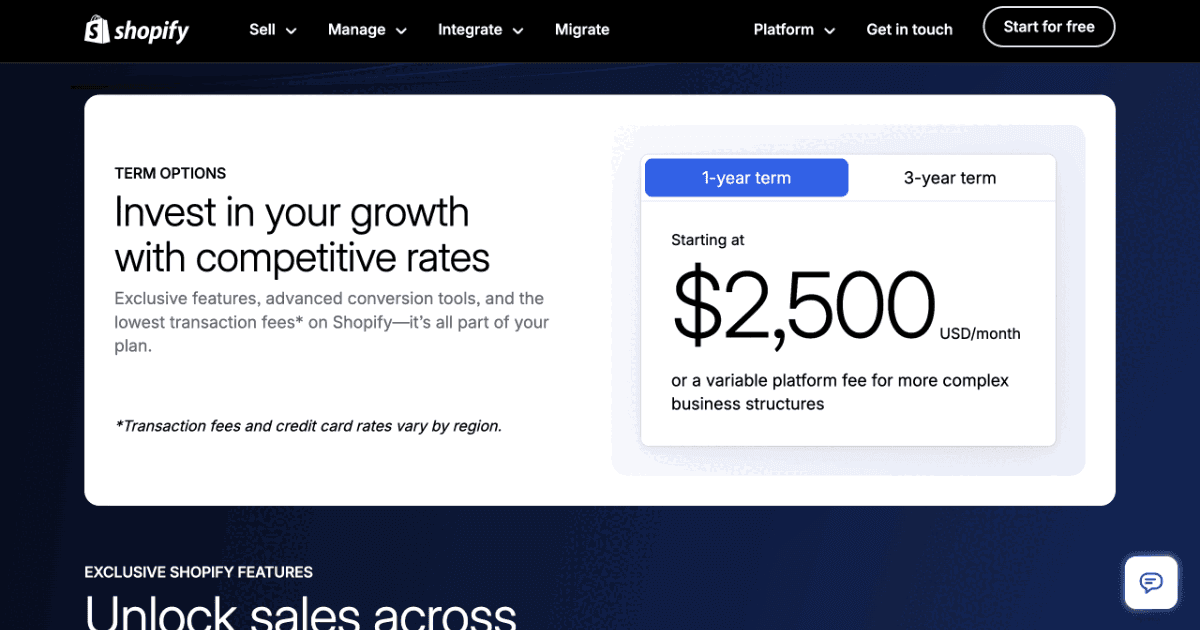
Shopify's standard plans don't include wholesale features. To run wholesale on Shopify you need:
Shopify's native wholesale features - company accounts, net terms, volume pricing - came off Shopify Plus on 2 April 2026 and run on every paid plan. Three active B2B catalogues is the ceiling below Plus, and they are assigned through Markets rather than to a company, so a farm pricing each account separately runs out of them well before it runs out of accounts.
Shopify prices last verified on 7 August 2026.
Why eggs specifically don't fit Shopify
Three things about egg wholesale that Shopify isn't built for.
Constrained supply
Hens lay what they lay. Production swings with the season - shorter daylight, the autumn moult, weather. When stock is tight, the right move isn't a flash sale - it's fair allocation across standing customers, so everyone gets *something* rather than the fastest-clicking new visitor taking the last 12 trays.
Shopify's inventory model is built for retail abundance. First-come-first-served, infinite reorder potential, dynamic pricing to clear stock. None of that applies when extra-large is being rationed across a handful of café accounts in November.
Wholesale Handler shows current stock for any product you count and lets you set customer-specific price lists, so allocation under shortage is a workflow you can actually run. More on that in How to plan egg orders around seasonal production.
Trays, dozens, and size substitution
Eggs sell in non-standard units - trays of 30, dozens of 12, half-dozens of duck eggs. Sizes (medium, large, extra large, mixed) are sometimes interchangeable. A café that normally takes large will accept medium when large runs short.
Shopify wants this modelled as separate SKUs or rigid product variants. A customer phoning to ask "have you got mixed if you're out of large?" isn't a checkout flow - it's a wholesale conversation.
Standing customers, not browsers
Wholesale customers aren't shopping - they're reordering. The Blue Door Café across town has been taking three trays of large and a tray of medium every Tuesday for two years. That kind of customer doesn't want to browse a catalogue, view product photos, read descriptions, or recover an abandoned cart. Last week's order with one line changed is the entire interaction.
Shopify's entire interface is optimised for the opposite - first-time visitors deciding whether to buy. Every feature that helps a retail conversion (urgency banners, related products, upsells) is friction for a standing trade customer.
What an egg farmer actually needs
The wholesale workflow for a small egg farm has a few specific shapes that Wholesale Handler is built around:
- Standing customers reorder from their last order, not from a catalogue
- Standing orders that place the same order every week, two weeks, three weeks, or four weeks, automatically at that delivery day's cutoff - with pause, skip, and schedule updates built in
- Stock visibility so you can run allocation under tight production
- Customer-specific price lists for café / restaurant / farm-shop pricing
- Delivery day scheduling so customers only see days you actually deliver to them
- Cutoff times so Tuesday's drop locks in by Monday afternoon
- Invoicing on terms, not card-at-checkout
Wholesale Handler covers all of this on the entry plan. None of it is locked behind a higher tier.
If you've already started selling eggs wholesale, the related practical guides cover the day-to-day:
- How to set up your first wholesale egg customer
- How to invoice wholesale egg customers
- How to make a packing list for wholesale egg deliveries
- How to stop taking egg orders on WhatsApp
Who should use Shopify
Shopify is the right tool when retail is the actual business:
- You sell eggs directly to consumers (online shop, doorstep delivery, subscription boxes)
- You run a farm shop and need a point of sale
- You want to sell on Amazon, Instagram, or other consumer marketplaces
- You have the time and budget to run marketing campaigns and theme customisation
If that's the shape of your egg sales, Shopify is excellent - stick with it.
Who should use Wholesale Handler
- Your wholesale customers are cafés, restaurants, farm shops, hotels, or other trade buyers
- You have somewhere between 5 and 50 standing customers reordering weekly or every two weeks
- You don't want a percentage skimmed off every order
- You'd rather invoice on net terms than chase Stripe payouts and chargebacks
- You want allocation, stock visibility, and customer price lists on the cheap plan, not on enterprise
- You want a phone-installable app icon for yourself and your customers, opening in its own window like a native app, without going through the App Store
The scope argument
Shopify is a retail ecommerce platform. Wholesale Handler is a wholesale ordering portal. They aim at fundamentally different problems.
If consumer egg sales are the bulk of the business with a few wholesale accounts on the side, Shopify with a wholesale app might make sense. But where wholesale is the actual business - where the week is shaped by what the flock laid and which trade customers are ordering for Tuesday - a retail platform is pulling against you.
The same argument runs for fresh produce wholesalers on Shopify, where the stock changes weekly rather than seasonally.
Last verified 7 May 2026.Relative time loading...